Showing posts with label life. Show all posts

Friday, February 12, 2016

Indigenous

I didn't know people still did missions like this. I felt like I was witnessing firsthand some of the missionary stories of my childhood while Helman told us about his ventures by canoe into the heart of Colombia. Guerrillas, midnight assaults, capsized canoes, planes with no seats that transported cows as well as humans, where the pilot had to stick his head out the window to be able to land.

That's the real deal.

And I didn't truly understand what the ladies at our conference had gone through to get to us until we took the relatively easy bus trip to San José del Guaviare, a mere 2.4 degrees from the equator and only 4 hours from Villavicencio, Crisalinco's home base. This was the closest Crisalinco training center to reach, Helman informed us. No joke... some of the women had traveled 14 hours by canoe, 2 days in a bus, and taken two planes (some of them doubtful as the one I mentioned above) to be able to come to the conference. They're incredible.

We visited two different indigenous groups who live near the city of San José. First were the Nukak, second were the Hiú.

The village of the semi-nomadic Nukak probably impacted me most of anything that I saw while we were in Colombia. I'd love to post photos, but... this is one of those moments when I honestly can't post many. If you're interested in demographics and a description of these people and how to pray for them, take a look at these websites:

https://joshuaproject.net/people_groups/11966/CO
http://www.survivalinternational.org/tribes/nukak
https://en.wikipedia.org/wiki/Nukak_people

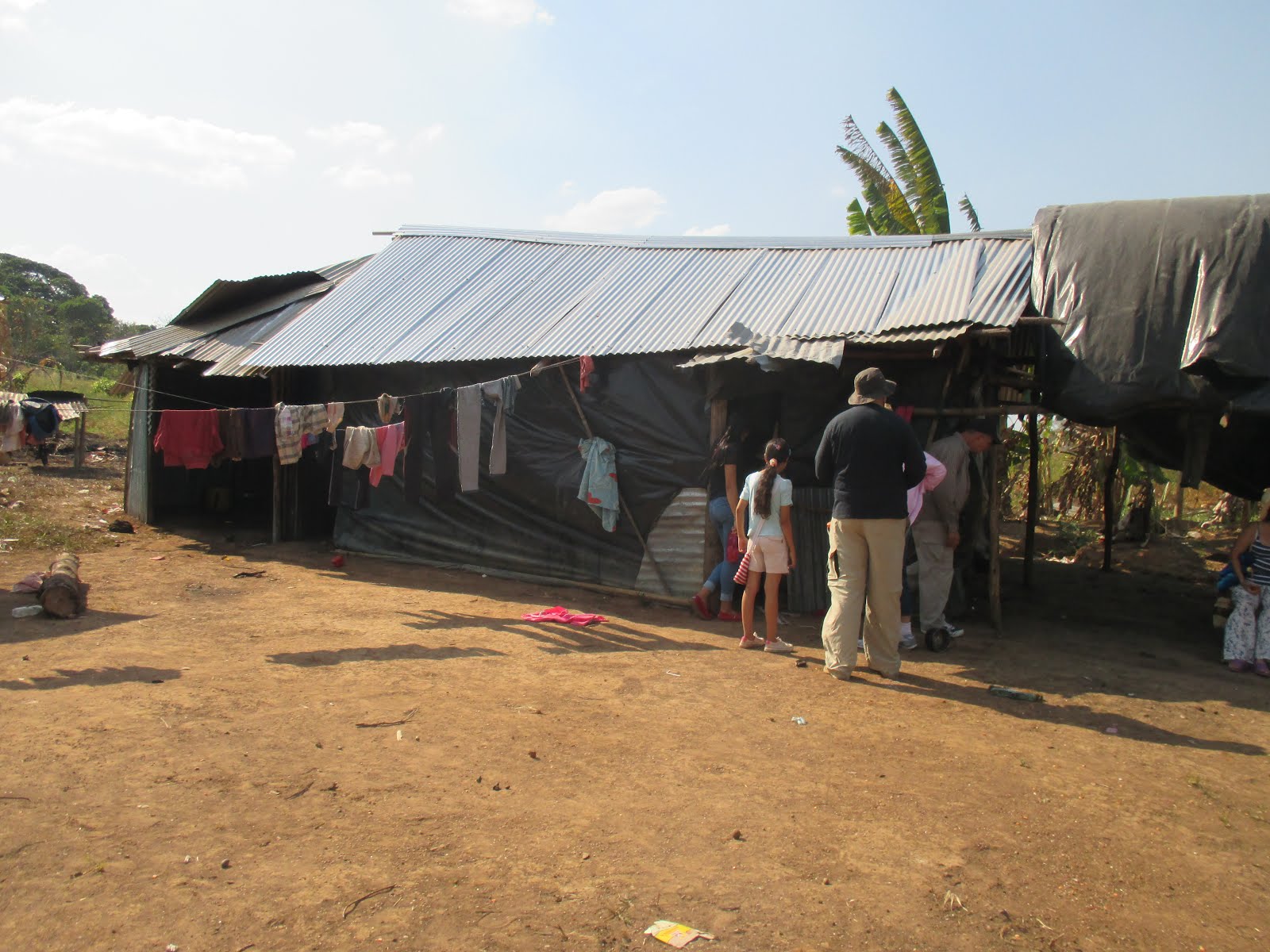
This is how they live, this is where they eat. We visited their homes and talked as much as we could-- Nukak isn't a common language, let alone a written one. Stealing is a core value to their society, because it's how they survive. Governmental programs worth hundreds of thousands US are sponged off by corrupt politicians, and only a sliver of the aid makes it to the communities, where it's typically poorly applied and no training is provided. Helman says they need a missionary to come live among them full time, adopting their customs and living life with specific values to show them morals they haven't learned quite yet and teach them to read, so they can study the Bible for themselves as it's developed in their language. Learning ethics would also need to be learned, since although there is a school built in the community, the students typically only stay for an hour before they decide to go home. There's more I could share here, but again... I feel it's not something to be made a spectacle of. I'd love to tell you, though, if you feel like asking!


This is Friendly Fred, next Christmas's dinner on four feet. Watch out, Fred!
He was quite receptive to our group, and followed us around faithfully.

This guy is the hope of Crisalinco for the Nukak. They don't have a tribal leader,
but this man has gone through Crisalinco's training and can now read and write.
As he continues to grow, their hope is that he will rise in the esteem of his community.
He and his wife came to visit us at our hotel since we missed them in the village.

The other tribe we visited was the Hiú. They are way more settled in than the semi-nomadic Nukak, so their cultural development is also a lot farther along and their dwellings are more permanent.


I have searched online, but I can't find any extra information about them! Maybe I don't have the right spelling or they go by another name. This group of people, though, was a lot more ready to engage with us. The language barriers was not as great, and we even got to tell the kids a Bible story and sing Father Abraham and The Wise Man Built His House Upon the Rock. I pulled out my extensive Casa Grande training as Kids Club emcee, though we were definitely all following along with Helman. Who is DEFINITELY in his calling as he relates brilliantly with people, up to jumping into a river to race some of the boys.

We also got to see their process for making cassava bread, which they bake on top of a tin roof in the sunshine.


These mud stoves last up to a year before needing to be rebuilt.
Turtle soup, anyone?
Seriously.
They make and sell these manillas, or bracelets... we bought them out.
Also got to try this hunting bow... and the spearlike arrow that went with it. It was fun,
but my arrow didn't make it far.
Just tell me this doesn't look refreshing.


I got the pleasure of holding this little princess for her mom for a while.
She was a cuddler!


Obviously... this makes you think. They live without so many conveniences I consider "necessary." Their lives are simple, but they are interested in each other and interested in creating and enjoying creation. It's an entirely different mindset, and taking the poverty and some of the more controversial moral systems out of the picture.... there are a lot of parts of their existence that are simple and good.

What does it mean to be indigenous?
Dictionary.com helped me out there.


adjective

1.
originating in and characteristic of a particular region or country; native(often 
followed by to):
the plants indigenous to Canada; the indigenous peoples of southern Africa.
2.
innate; inherent; natural (usually followed by to):
feelings indigenous to human beings.
It means to belong. To be born someplace, raised someplace, to be part of the fiber and DNA of that place. Because if a location is inhabited, its inhabitants are what give it the flavor and character that it has. The DR has one flavor... the Colombian flavor has a completely different one. And both countries have subflavors, like these original groups. There are 80 groups like the Nukak and Hiú in Colombia, I found out.

Yet these indigenous groups are the original Colombians, like the native American tribes are the original Americans. And somehow, whether by oversight or by design, the collective development of the country around them passed them by. They live by different rules, different means, different resources. They are effectively in that world, but not of it. They are part of the cultural makeup, but they don't affect it.

Here's my thought to ponder, and I'd love some discussion on the topic as I perfect my parallel here...

As Christians, we're now indigenous to the kingdom of God. We are part of its fiber, what gives it flavor, yet like the Nukak, we live semi-nomadic lives in a land not our own. We live by different rules, different means, different resources; called to be in this world, but not of it, and its progress "forward" may seem to leave us in the dust as we struggle to avoid taking on a worldview that goes against our ancient creed. However, we are not called to live only amongst ourselves. We are called to be the flavor and the color (the salt and the light) of this land we travel through, as well, leading others toward our home country.

Indigenous.


Credit where credit's due: Most of the photos in this post were taken by my teammates, particularly Rod and Peggy Stewart and Tammy Springer. They were doing such an awesome job, I decided not to try taking yet another expensive camera through some of the crazy zones were were passing through.

Monday, October 19, 2015

No longer a slave to fear


I feel led to share this part of my testimony with you because this is something we all experience... even though (and maybe because) it's a lot more vulnerable than my average blog post. But if I can be honest about my story on my way to freedom, maybe you can too.

-------

I had the privilege of interpreting for a thirteen-year-old American girl in another part of the Dominican Republic earlier this year. Raised in a culture of missions, she had a clear message she wanted to share. Every time we went out on an outreach, she found a likely looking girl on the sidelines and encouraged her to believe a life-changing truth: “Did you know you are the daughter of the most high King?” You are not alone; you have a Father right with you.

A Father. More than just a male parent, biblically this tough concept implies a loving, caring, wise, involved, proud, reliable, trustworthy, admirable authority figure of integrity and strength. And the parent/child relationship implies a dependent relationship of trust and unconditional love, in which the child knows Daddy has the child's best interest at heart and will love him no matter what. Tall order? Probably. Earthly dads hardly ever live up to that descriptor, even the best of them. Sad to say, in the DR we often see a shortage of examples of fatherhood of any kind, save the dads who drop out of the picture, abuse their children, and "father" kids with lots of different women. 


I know my dad isn't perfect, but honestly I have a hard time identifying his failures. He's about as perfect as it gets. And my mom is also extraordinary. I know both of them love me unconditionally and would never try to hurt me.


So how did I ever end up struggling with the mentality of the orphan spirit? I could probably delve into my childhood and dredge up a handful of wounding experiences, not necessarily at the hands of my parents, but through rejection or disappointment from other people I thought I should be able to trust. I'm pretty sure all of us could. Though the "how" is important to our healing, it's different for all of us. The point is that all of us, eventually, have to deal with orphan thinking, which is characterized by self-reliance, love of the rules, insecurity, striving for acceptance, shame and guilt, self-rejection, and seeking comfort in counterfeit affections like addictions and escapism and compulsions. Orphans hold others at arm's length, afraid of being disappointed.


A couple of years ago I found myself at my wits' end.  I was working two jobs plus volunteering as a worship leader 6 hours a week plus devoted to working out for a couple hours each day plus trying to be a good roommate. I had just lost a lot of weight and changed myself completely, but I could see myself on the verge of gaining it back because suddenly food was my answer to every question and my hard-won self-control was going down the tubes. Then I found out I needed a hip replacement and I suddenly had no idea which end was up or even who to ask for help-- I felt like an inconvenience and a burden. And I feared asking for help because I was afraid I was important to nobody but me, and that others would disappoint me. And my insecure mind consistently focused on all the ways I felt I didn't fit in whatever situation, rather than on how God wanted to use me and mold me the way he made me. 


Yep. Wits' end. Out of control. Other little selfish or greedy behaviors started manifesting themselves, and I felt like a failure because I couldn't live up to the standards I had set for myself. Even a twinge of loneliness sent me scrambling for a spoon and the peanut butter jar. I came to the realization that I had an eating disorder, compulsive overeating, of all things... So, orphan mentality in mind: In that scenario, we see striving, busyness, shame and guilt, insecurity, over-self-reliance, self-rejection, and seeking comfort in counterfeit affections and addictions! I was a textbook case of orphan mentality and slavery to fear, and I didn't even know it. 


I have gained a lot of the weight back. But I have come to recognize that this, too, is part of my journey to find a healthy space. 

Seeking to deal with my "symptom," the disordered food mentality, I spent time talking and praying with friends. One of them prayed out against an "orphan spirit," a concept I had never considered at that point. Orphan? Me? With my awesome loving parents? Yet... who was this person inhabiting and consuming my body, who ate like she didn't know where her next meal was coming from? As if somebody else who didn't care about her needs at all might get the pleasure of that morsel if she didn't snag it first? As if she didn't have a place just for her at the table? I am living like an orphan, I realized with shock.

Not too long after that, I read Heidi Baker's Compelled by Love, in which she describes an orphan child sneaking a Coke from the family fridge when he could have just opened the fridge and taken it, not able to grasp the fact that the Coke had been put in the fridge for him in the first place. That's... me again, I recognized. In so many ways, spiritual as well as literal.


A spontaneous prophetic song in Spanish by Marco Barrientos put me in tears not long after that. "Believe that I am your father, and you are not an orphan anymore! Believe that through the blood of Jesus Christ, you have been redeemed. Believe that all of your needs have been supplied for through my riches in glory. Believe that for you there is a place at my table! That you are not a stranger or foreigner. But believe you are a citizen among the saints, and a member of the family of God!" The simple truth of that passionate prophecy continued to guide my heart toward the truth: I needed to find my place at the table of God.


As we grow in confidence in our identity in Christ, each of us must deal with our own walk from slavery to sonship. So many of our offenses and reactions, and even the ways we treat other people are embedded in a belief that we must try harder, perform better, be something other, and earn respect and advancement. Orphans are willing to put others down if it will take them higher. Orphans are willing to blame authority if it means a better situation for themselves.

Sons and daughters don't need that. They understand that their position is secure because it's based on their identity as children of their father, not on their actions as mere employees or strangers who must prove themselves before they can belong. They are already invested in the family business because it's their inheritance. So the journey from slavery to sonship does not merely mean an identity change-- it requires a mentality change as well.


In fact, it represents our perceived identity as humans to an uncanny degree-- it even shows up in pop culture. Take for example all 3 main characters (Harvey, Louis, and Mike) from the TV show Suits. Harvey is a self-made man, disappointed by his mom's infidelity and abandonment in his youth, now an externally successful lawyer internally closed to legitimate love and feeling. Louis constantly seeks affection and approval and is willing to put down or betray others to get it. Mike was actually orphaned as a kid, and through his masquerading as a lawyer, is seeking a place to belong as if he has no home. Did the show's writers sit down and go, "Hey, let's give all our characters orphan complexes!"?? I think not. The orphan mentality is ingrained in our broken state. 


Since my recognition of my orphan mentality, I have had to do battle with it. The war hasn't ended yet. My first year in the Dominican Republic I didn't really feel I had a home. New culture, new job, new family, no friends. New attack of the orphan spirit. I didn't even have so many of the things I count on for encouraging others-- not even a thank-you note to write in or a pencil to write it with. I've had it so much easier than so many missionaries before me, but I see those things as vital to my identity. So what did I default to? My "identity" as an orphan. Self-reliant, independent, and freaking lonely because I was afraid of crossing my perception of other people's boundaries. Life as an orphan sucks.

Then I started noticing the sons of the folks I work for. They are unafraid to let their personalities or their desires influence the group activities or atmosphere. That confidence brings their mother joy, because I think she knows (like the wise woman she is) that it's a sign of them knowing they have a place in their family. When we are confident enough to share who we are... we have more potential to bless other people.

I've been here more than a year now-- this is my home, too, and my community, if not my family. The same dynamics apply. And if I hope to be effective in ministry I need to be all that I am, with no apologies (unless of course I am in the wrong).

I am not their child. They don't owe me, and I'm not entitled. I don't want to inconvenience people... but neither should I live invisible. That prevents me and my personality, however crazy we might be, from being useful and impactful to other people. That insecurity and fear is what keeps me quiet when I have a chance to speak up. That's what holds me back when I have a chance to make a difference.

Living with less fear (because I'm still on the road to eradication of it) has given me more freedom to just be me. Living as a child of the king gives me a sense of authority and confidence. 

What if we all understood who we are as children of the king? What if we based our actions less out of fear that we would lose our hard-won position, or worse, never advance at all-- and based them more on our solid identity as children of a most high God? What if we walked in confidence and security, as well as the understanding that this means coming underneath those in authority over us to push up and make their vision come to fruition? 

Do you realize you are the child of the most high King? Do you know what that makes you? Do you know the inheritance that's yours?

Me, I have a place at his table.


(If any of the ideas in this post speak to you at all, I highly recommend Jack Frost's book Spiritual Slavery to Spiritual Sonship. A lot of the ideas in this post come directly from its pages.)


Saturday, October 17, 2015

Ridin' in Style...Dominican Style

My second year in the DR has increased my independence, so I'm learning all about ways to get out and about. Not many people own vehicles, so public transport is the option of the day! You can always call a taxi, but you don't have to as long as you've got a handle on the cars.

Ohhh G cars. And M cars. And CJ cars-- public transportation options known as carros públicos, or conchos, which run on routes like buses for cheap rates, will pick you up at any point along their route, and have no limitations on the number of passengers they carry. Literally. If you can still see an empty lap, the car's not full yet!  

Where these:

Get you this:

Possibly with them:

And maybe with them:

Hopefully with her!


But most importantly, they get you where you're going.The best part of this mode of transportation is that it's cheap ($20 DOP = $.44 US) and gets you from point A to point B and you don't have to walk. Upon further consideration, I must also point out that these are also the only good parts about it unless you include "it's always an adventure" on your list of assets.

The first question: Is it safe? There are stories of crazy drivers (but every driver here is crazy) and pickpockets riding a little too close to unsuspecting passengers, and you will end up having to walk a bit (possibly through doubtful territory) to connect the car route with your destination. However, if you follow proper Public Car Protocol (ie, don't pull out your cell phone, don't keep money in your pocket, avoid using the cars after dark) chances are good you'll avoid incident and be just fine.


To give credit where it's due, I have to say that the best photos here came from a Google search of "Dominican conchos"-- which I highly recommend you look up yourself because some of those pics are just mindblowing. It's kinda awesome... and one of those thing's that's pretty darn Dominican.

And however squished your concho ride might be today, just remember: it could always be worse!
                                                 

Thursday, October 15, 2015

Raindance

Even the slightest hint of rain gets me looking hopefully out windows these days. During a light sprinkle from a cloudless sky not too long ago, I convinced Nancy to brave the wetness to join me up on the roof (a favorite place of mine lately). The drops fell cool and refreshing on my skin, and together we saw both ends of a blazing rainbow in the distance on the golden horizon, our shared experience the pot of gold.

When it finally full-on rained, I dodged raindrops through the yard to run up onto the roof yet again and just soak it all in. I sloshed through puddles and turned my face heavenward, praying that it wouldn't relent until I was drenched clean through. And it didn't. Waves of raindrops blew over us on a persistent wind, trickling in rivulets down my arms and dripping off my hair. I found a puddle to perch on and sat there, a very very happy mess, smiling at the gift of a rainy day. 

I stayed until lightning streaked across the sky and I decided that being the tallest thing on a watersoaked roof was maybe not the most strategic position for survival. As I stayed low and darted for the stairs back down to earth, I heard a familiar whisper in the corner of my heart.

What if, every time you saw a remote possibility of getting drenched by my presence, a worship service or even just a few drops of my glory, you ran toward it with everything you are, hoping you will be completely soaked?

Only if we brave the droplets do we get the chance to be cleansed, which happens only if we saturate ourselves completely. Braving the rain gives us the opportunity to spot a rainbow, the promise of color to come.


Tuesday, September 29, 2015

luv u

As a proofreader and editor, few online abbreviations accost my creative conscience like the grammatically gauche "luv u." The simply sweet sentiment it serves seems squashed almost completely by the apparent lack of respect for proper spelling of the person on the other end.

But... my personal annoyance with the term aside, and for reasons completely unrelated to its grammatical disrespect, those words are hard to respond to or reciprocate. Why is that? I've recently had a few revelations about love, and I thought I would share them.

Nope, sorry, I have no announcements to make about my romantic life. Ah, well. However, I have been learning more about what it's like to love others on purpose... and even to have love for others (and from them) sneak up and surprise you.

In Greek, there are four different words for love. Storge, the unforced familial love. Phileo, the generous and affectionate "brotherly" love of close friendship. Eros, the love that's... a bit more than brotherly, if ya know what I mean. And lastly agape, the unconditional love.

It has been the development of storge and phileo that has surprised me most. God has blessed me with a few pretty unusual but pretty special relationships... friends that I never expected would truly feel close to me, a crazy collection of people I call brothers and sisters or family in general. Some of the things we have walked through together, and the way we've ended up pulling together on the other side, have made me realize that that "family" title isn't just for fun. I mean it. I love them. Which can feel a little scary sometimes (especially when some of them have the tendency to leave you the shudder-inspiring note, "luv you." They can't mean it....).

Understanding that lovely side of relationships changes things. And has brought a few revelations about love to mind.

1) To love is to leave yourself vulnerable, to let what someone else knows about you matter, and to trust them with that.

Few things are as painful as a previously close friend turning on you and using the things that the two of you shared in confidence to tear down your relationship with their own two hands. But to have a true relationship, you have to risk that vulnerability and recognize that their opinion of you is going to matter. A lot. And regardless of what they do with your confidence, you can love them anyway.

2) Satan will use the doubt of love to make us insecure and unable to trust.

Lack of love means broken relationships. If we doubt others' intentions toward us, it becomes extremely difficult to trust them at all... or to trust others we may come across later. When doubt becomes part of our relational pattern, we lose potential for the intimacy God designed as part of relationships. So we must first trust him with the people we decide to confide in, and make our own objective, then, to be people of integrity who never give our loved ones reason to doubt us. Not because we expect them to be able to deliver us the same, but rather because we do love them unconditionally and don't want to hurt them.

3) To love is to sign up for hurt. 

Not necessarily because of points 1 and 2, in which the other person betrays a trust or our doubts are justified. Simply put, it is impossible to pass through life without experiencing pain, and when something hurts those we care deeply about, it hurts us, too. When we sign up for love, we sign up for the other person's aches and wounds. Sometimes we sign up to feel pain they themselves do not have the capacity to feel as of yet.

We can only truly agree to love when we acknowledge this, and recognize that the relationship itself is worth all the pain it will bring. From a philosophical perspective, pain is one of the beauties of life... though it sure doesn't seem like it when we pass through it.

4) Loving is worth it.

Despite the hard moments, the occasional betrayals, the rifts that arise, we grow through love. Life is enriched through love. Especially love that purely desires the thing that is best for the one who is loved.

Truly loving someone gives us the ability to serve them without seeing it as demeaning or somehow beneath us. It enables us to be for them the very thing that we would desire for ourselves if we could give voice to that deep, often hidden longing. And the beauty of love is that it often has the tendency to come full circle: when we love others well, they may very well come full circle to love us in return.

Being loved by someone, in a pure, unforced, self-sacrificing sense, is the sweetest gift you could receive. It's worth the pain. Better to have loved and lost than never to have loved at all.

luv u.

I've had to learn to read it for the sentiment it conveys. There is somebody on the other end of that phrase who cares. Cares enough to write me those words, in fact. So at the very least, that person is my friend. And I very likely love them too.


Friday, September 4, 2015

The Distance to Liberty Hill

Sometimes you don't realize the blessing you've received in relationship until the sweetest ones of your life land at your door once again... and you realize that distance has not changed you, only separated you, and you love each other as much as ever.

I used to live in a place called Liberty Hill, and when my heart thinks of home, my imagination runs to that door. Friends live there, and some don't live there though you forget that sometimes because they always come, in a sweet community and fellowship of girls at the foot of the Rockies. They laugh and the door revolves and somehow the pragmatic sense of everyday life does not touch the charm and captive idealism that sparkles with the high-altitude sun and azure sky that always seem to shine down on the garden parties and birthdays and snow days. I found myself there, and I grew and changed and somehow they loved me anyway.

They become part of you, you become part of them. A heart sisterhood.  And if you leave, part of them comes with you.

I left them to move to the Dominican Republic. They encouraged me to do it. "Within a year, you're going to find yourself on a plane headed to Latin America," Nicole prophesied. "If you don't do it, you're going to be sorry you never did," Lauren once told me. Though she couldn't say goodbye to me when time came for me to go. "See ya buddy," was all she said, and turned her face away.

We all like the going, but none of us like goodbyes.

The in-between times last long... mottled with bright spots when we write or talk or visit. And I sometimes wonder why I left.

The hellos seem just that much sweeter.


Wednesday, August 26, 2015

Miracle of the Firefall

Staring into a wildfire down the sights of a water pistol: A decent comparison for fighting fires in the DR during a drought.

We've had one rainshower in the last 3 months. No drizzles, no sprinkles, no afternoon cloudbursts. So the grass has dried into straw, palm-thatched roofs wait like ready kindling, and most of our yard resembles a tinderbox.

Enter a neighbor who decided today is a great day for brushburning in the field next door.

*FACEPALM*

Around 9:30 Tim comes in grumbling about the stupid neighbor who has a brushfire he can't handle.

Trena: Did you call the fire department?
Tim: They won't do anything anyway. They probably don't even have water.

The fire department unfortunately has the reputation of showing up with empty water tanks, it's true. And our electricity is out, though we're on generator power, so we have limited access to the water that's in our own well.

Tim headed back outside, and Trena and I exchanged looks. Any report of fire in this dry spell is not encouraging. And then we both paused.

Trena, frowning: I hear it.
Me, with a wash of memories from the last time I heard this sound: I hear it too.

We get up and dash outside, neither of us expecting what we saw. Only feet from the fence separating our property from the neighbor's goat pasture was a wall of flame, steadily eating its way closer and closer to our parched grass and thatched roofs.


My mom read me Little House on the Prairie, folks. I know what happens when fire gets out of control in a dry field.

I've encountered fire a bit too closely on a couple of occasions now. The car accident with TUFW a couple of years ago, two years of horrendous wildfires in Colorado Springs, a couple of instances of near-wildfires started by crazies out near Cottonwood Creek behind the Doneys' house. Now this one.

So this is not a welcome sight.

Trena: My birds are going to die!

She rushes to find a garden hose to start dousing the thatched roofs of the birdcages. A cloud of smoke is wafting toward the poor trapped birdies.

Me, I stand there looking useless and contemplating homelessness, awash in the crackling, rippling flames and the burning heat that descended on us from above, amplified by the grass-fed bonfire next door. And then I get the brilliant idea that I am no good to anybody wearing flipflops, and I race upstairs to change into sneakers and frankly consider what I should pack if it comes down to that. Dratted panic.

Meanwhile, Conrad does call the fire department. And I join Yolanda and we race through the house shutting the persianas, the slatted window "shades" that are usually open all the time to let the breeze through, to keep them from letting in the smoke, which is already settling in an unsettling blue haze in the air.

And then I take these pictures and realize the only thing I can do is get people praying... so, thank you social media!

The fire department arrives within minutes, and they fight alongside our guys. But as suspected... they only have half a tank of water. So although from one side they can start drowning the flames with water from their hose, from the other side there is nothing but our yard workers pointing garden hoses with doubtful pressure and firemen running around with green branches they cut from the trees in the burning field.


Garden hoses were not meant to be firefighting tools, friends. And yet they were pretty much our only (physical) hope.


The firetruck quickly exhausts its supply of water, but by then thankfully it seems we are down to smoldering coconuts and palm trunks... no more open flames. Fire contained.


Firetruck and fire fighters pack up to leave, but they are no sooner down the road than we have another outburst of flames! Our guys all jump the fence and scramble to reconnect the hoses at a better angle to protect our property, and Conrad grabs a branch to beat it out DR-style. We don't bother to call the fire department back... with no water, what can they do anyway?

We are all grateful when they're successful... and we keep an eye on that field the rest of the day, thanking God for his protection. Bit nervewracking, that!

The following day, I ask Genaro to take me out to the field where the fire started because I have a sneaking suspicion about what I'll see: even though the fire came close, I had noted that it was almost as if there were a line that it did not cross. I wanted to see if that was true.


The goat field was coal black, but next to our property, in front of that big house (La Casa Grande) there in these photos, you can see the hedge of protection. It's almost an even line of untouched grass around our property. except the areas we doused with hose water, where it's wider. In the picture just above this paragraph, if you zoom in you can see that the leaves on the guayava trees are scorched at a level higher than the thatched roofs of the birdcages, but no sparks flew and caught flame. I know it's because people prayed.

I love seeing God's hand at work... 

A thousand may fall at your side,
ten thousand at your right hand,
but it will not come near you.
If you say, “The Lord is my refuge,”
and you make the Most High your dwelling,
No harm will overtake you,
no disaster will come near your tent. (Ps. 91:8,9,10)


Friday, August 21, 2015

The Grit.. The Grime... A Tropical Summer

Today was the kind of hot, tropical day that makes you wish you lived closer to the beach... when you sit in front of your fan, tongue almost lolling out of your head like one of the four dogs who sit outside your door because they wish they had a fan like yours, and still the sweat pours and seeps from your pores, from pores you didn't know you had, and every time you touch the back of your neck to catch a droplet of sweat, your finger comes away with a layer of grit and grime that maybe came half from the dusty, dry-humid air and half from you yourself. And you sit, sticky and damp and moist, until you have to get up and do something. When you make it back to your fan's soothing puddle of air current, you are no longer moist. You are pooling and puddling and resigning yourself to the fact that this is how it works... and pretty much willing to swear lifelong fealty to the fan.

Good news is, for you this is normal. Everyone else carries around their own sweat rag and has a sweat spot similar to yours. And so despite all the aforementioned measures... you hardly even notice beyond commenting to your friend, "It seems awfully hot today, doesn't it?"

On days like today, you are grateful for your shower that finally comes at 10p.m. because it means you can relinquish the grit and the grime and wash away the weary worries and sweaty stickiness and fall to sweet sleep under the beautiful breeze of your best friend, the fan.

Long live electricity.

Monday, May 11, 2015

Reentry 101

We all know what happens when a spaceship re-enters the atmosphere: it superheats, and unless it has been built to withstand the friction it encounters as it flies back toward earth, it might disintegrate or burn up before it gets there.

They say there's a similar process for missionaries, too, but I hadn't experienced it before so I thought I would note it.

It really didn't help that I don't do big cities on an average day. Getting a taxi to the hotel where I'd meet my family cost me an hour and a half, three failed calls to taxis who didn't send drivers to the airport, and $80 I didn't have ($$$).

The hotel required payment for their internet, and the price tag was huge ($$$).

I was also emotionally ragged from the travel and probably some hormonal jazz going on. Plus I hadn't eaten and there were no restaurants nearby. After I talked to my parents, who were still en route, and they encouraged me to just order room service ($$$ again), I collapsed and had an exhausted, hungry cry before going to clean up and get a shower while waiting for the food to arrive.

I'd thought that might be the worst of it.

But the next day we decided to eat lunch in one of the museum restaurants in Chicago. Not going to lie, I'd already had a few overwhelmed moments that morning when I realized that Americans actually stand in a clear, calm line to wait for tickets... not something I'm super used to seeing anymore, I guess. But I walked up to the food serving tables in the cafeteria line at the museum with a sudden sense of overwhelming desire to just leave. Here I am, staring suddenly at an excessively laden steamtable and wondering why I can't see individual items. Kale salads and three kinds of soup as well as a pizza table and a pasta bar, not to mention the desserts and the fruits and seafood. And I got grumpy. Couldn't decide, felt like I was treading water or maybe drowning in it, retreating into myself.

And my mom looked at me. "Are you okay?"

That's when I realized. "I think... I'm doing reverse culture shock right now... sorry..."

"I wondered," she said. Oh, sometimes mommas are so wise.

And all that over lunch.

And then... clothes shopping. Where's the line between "I get this because I need it and don't get to a store very often" and "well, there's money I could use for this, but technically it's not in the budget"?

Okay, so re-entry was maybe not as easy as I'd expected. Going from a developing country to a five-star hotel in Chicago for a weekend with my family overwhelmed me with a sudden influx of luxury and excess I'm just not used to. I live on a pretty tight budget and the mental processes to match... if I don't have the money, I shouldn't spend it.

But I made it this time, by God's grace (and good deal of grace from everyone else, too. Haha). And I guess next time I'll know better what to expect.

Friday, February 27, 2015

Dominican Cuisine!

Caution! Don't read this if you're hungry! For... probably a couple reasons. ;D

I think one of the first questions we ask when we start thinking about another culture or country is "What do they eat?"-- maybe because our time spent around the table defines us. Maybe because foods that we like in common give us shared experiences. Maybe because our foods describe our culture more concisely than a sentence ever could.

So in the Dominican Republic, what do people eat?

Well, let's start out with some semi-familiar ground... Betcha can´t guess what these are!


All cereal, regardless of the presence of Tony the Tiger or that weird-looking rooster, is referred to as cornflé, cornflakes. (I once asked a girl what they call froot loops. "Cornflé!" she answered. Well okay then! Also, I got made fun of for eating that chicken and vegetable platter at the bottom. I could have been eating traditional Dominican fare that day! Even if that's what they eat at home all the time, Dominicans love their traditional foods. And to be fair, peanut butter is not your average Dominican fare. Most have never tried peanut butter and jelly; in fact, if they eat it at all, they usually eat it with the national casabe bread, which has been made here since before Columbus made his gallant entrance on this island. It's made from ground up yuca root (which is also frequently served boiled, as pictured below right) and many times casabe is flavored with garlic. With peanut butter? That's an interesting combo.


This meal is a pretty typical Dominican lunch. Lunch is the big meal of the day, the one the housewives or their household helpers actually cook for. If a Dominican hasn't eaten rice? He hasn't eaten. Also, Dominicans generally do not eat leftovers. If there's food remaining from lunch at the end of the day, it might get eaten for supper, but it doesn't usually see the table again. They cook what they need for a given meal or a given day, a habit that's probably based on not having an excess of food to prepare, as well as not having a refrigerator or predictable electricity for a fridge if they did have one.
It's easy to see the rice and beans on this table. The casserole pan to the left was mashed potatoes, if I remember correctly (although it could have been mashed plantains, too) and the one at the very top was arepa, a corn and coconut milk cake that's very traditional, and loved by most Dominicans. The poor burnt offering on the bottom... well, that was my attempt to show one of the daughters of the family I stayed with how to bake banana bread from a box mix (don't ask me whose fault that was!). Dominicans don't bake; even if they have a super nice oven, it gets used for storage and they buy their breads and pastries from a panadería, a bread store.

Rice is so important, it gets served a variety of ways. With beans over the top, with pigeon peas cooked inside, with a tomato-based cooking liquid, or even with milk, cinnamon, and sugar-- arroz con dulce.


Despite the fact that lots of fruits and vegetables are grown here in the country, very few actually get eaten regularly. The biggest exception are the viveres, or root vegetables, like potatoes, sweet potatoes, yuca root, and plantains.You saw the yuca above, and you've prooobably seen the plátanos in the grocery store at one point or another.

Here are a few other fruits... Avocados here are huge, too. Literally.
Cereza cherries, a tropical variety with strange seeds inside that tastes like a delightfully citrusy cherry.

Coconuts are the big green ones, and limoncillos are the little green ones that grow in bunches like grapes.

These are chinola, or passionfruit. This is one of my favorite discoveries down here... their juice is delicious, if a little tart.

This is pineapple and mango. Papaya is also really common here, but I didn't have a picture of that one! Our mangos got huge last year, though.
And we can't forget coffee! So traditional Dominican coffee is made in a greca, or a Greek style coffeepot, and since it's super strong, it gets served by the ounce in small cups. Or maybe plastic Solo cups, depending on the occasion. They usually add a tablespoon of sugar, and maybe some milk.


And here below we have my buddy Conrado, displaying the traditional Dominican soup sancocho.


This one's breakfast: fried cheese slices with a heaping helping of mashed plantain, known as mangu.
 Not gonna fib, though... sometimes they eat stuff I think is weird. Like... pig innards.

Or smoked fish that makes the whole house... smell. Actually, the bacalao isn't bad (salted codfish). It's the smoked arrenque that is pretty, well, rank.
But if you go to the beach, you might get to sip some coconut water... or munch on a candied coconut/cinnamon confection I don't have a name for.


Probably the overall favorite is helado from the local ice cream shop-- Bon. This one's a frozen yogurt blended with frozen fruits. And it's tasty!


 There you have it... a few things Dominicans like to eat... and a few I prefer. Which ones look tasty to you?